The 7 “Levels” of Futurists
Everyone Can Think About the Future. But Not Everyone Is a Futurist.
It is a provocative statement, but a needed one.
Many people work with the future in some form. Economists model it, technologists project it, strategists plan around it, climate scientists simulate it, and executives speak confidently about where it is headed. Entire industries are built on anticipating what comes next.
Yet not all of this is foresight, and not everyone doing this can or should be called a futurist.
In our effort to broaden the field and make futures studies accessible and relevant, we have also blurred its boundaries. When everything future-oriented is labeled futures and foresight, the term begins to lose coherence. And when a discipline loses coherence, it loses its contribution.
So it is worth being precise.
Talking About the Future Is Not the Same as being a Futurist
Forecasting extends trends. Modeling quantifies probabilities. Strategy makes directional bets. Technology discourse often assumes inevitability disguised as progress. All of this can be rigorous. Some of it is valuable.
But foresight operates from a different starting point.
Futures Studies, by definition, is the study of possible, plausible, probable, and preferred visions of the future – and of the myths, stories, and worldviews that shape how those futures are imagined. It is the what and the why - what could, would, and should happen, and why we think these things.
Foresight is the application of Futures Studies. And strategic foresight applies futures studies to inform and make decisions in the present. All three come together to form the field of Futures and Foresight.
This is not a loose metaphor. It is the textbook definition of the field.
Futures and Foresight is concerned with what could happen, why certain futures appear more plausible or desirable than others, and how our assumptions and biases shape those judgments. It deliberately expands the future into multiple trajectories and questions them before narrowing choices in the present.
If the future is treated as singular, inevitable, or already embedded within current trends, we are no longer practicing foresight. We are engaging in projection.
Projection attempts to reduce uncertainty. Futures and Foresight works with it.
But even within foresight, depth matters.
The “Levels”
Not all engagement with the future operates at the same depth or ‘level’, and confusion often arises when these different forms of work are collapsed into one category.
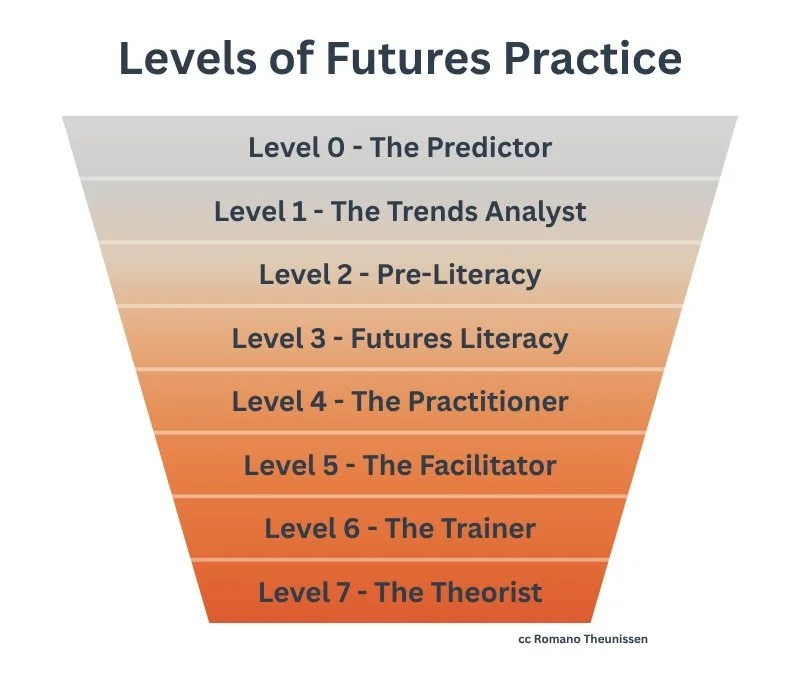
One way to clarify the landscape is to think in terms of levels of engagement — not as a hierarchy of worth, but as distinctions in depth and function.
Below is an attempt at clarifying those depths.
Level 0 – The Predictor
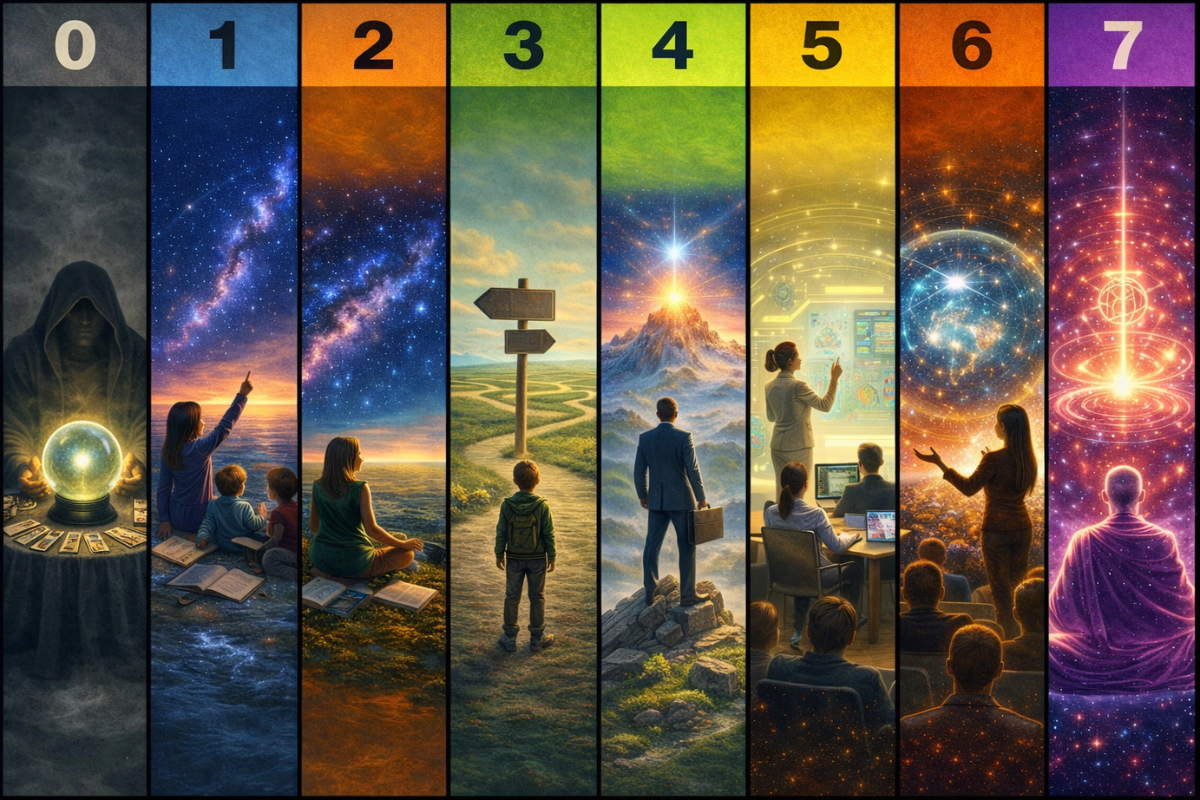
At this level, the future is framed as inevitable. Statements are declarative and confident. Alternatives are rarely entertained, and agency is minimized. This mode dominates headlines and keynote stages. Think of the tech CEO who says that the future is AI…or a few years earlier when those same CEOs said the future is WEB-3, or the future is Social Media. At level 0, the main aim is to reduce complexity, inspire confidence in the speaker's own motivations, and often also reduce agency.
This is not a Futurist.
Level 1 – The Trend Analyst
At level 1, patterns are analyzed and extended forward. Data may be sophisticated and probabilistic, yet the underlying assumption remains that the future is largely an extension of what is being seen in the present. The work is useful and necessary, but it still operates within and is predicated upon trajectory thinking. Trends and trend analysis can play a vital role in Futures and Foresight work. However, stopping at the analysis or extension of trends is simply a more sophisticated version of prediction.
This is not a Futurist.
Level 2 – Pre-Literacy
Level 2 is where we begin to recognize that prediction has limits. Deterministic narratives seen in levels 0 and 1 begin to feel insufficient. People at level 2 begin to ask questions that fuel curiosity. This is often driven by high levels of self and professional reflection. Futures and Foresight language may start to appear at this stage, though the implications of this language are not yet fully internalized. Level 2 is a pre-condition for entry into Futures and Foresight worlds.
This is early awareness. This is curiosity. This is not a Futurist.
Level 3 – Futures Literacy
At this level, individuals understand that ideas of the future shape present actions. Multiple possible futures are explored consciously, and anticipatory assumptions are surfaced and questioned. Often this work begins at a personal level, reshaping how individuals understand uncertainty in their own lives. We can think of Future Literacy as the ability to read with the later levels being able to write books.
Everyone can develop this capability. And everyone should.
But they are not yet Futurists.
Level 4 – The Futures Practitioner
At level 4, the practice moves external. Structured methods are applied, such as scenario development, systems mapping, various forms of layered analysis, backcasting, and more. Futures and Foresight informs decisions and strategy in contexts beyond the personal. At this level, practitioners tend to have deep industry expertise and often apply foresight individually or within small teams. Much of our professional practice operates here.
This is where we can meaningfully begin calling the work futures or foresight.
This is a Futurist.
Level 5 – The Futures Facilitator
Level 5 moves us beyond the individual and is where Futures work becomes collective and participatory. Futures Facilitators tend to guide groups through explorations, uncover shared blind spots, and enable organizations or communities to surface and confront their own preferred futures. The core difference between levels 4 and 5 is fundamentally about an understanding of interaction dynamics when in groups. This level also requires a deeper understanding of tools and methods used in Futures and Foresight, being able to deconstruct and reconstruct tools in order to meet participants more effectively. Most Futures Facilitators operate as consultants at small boutique consultancies, think tanks, as independent contractors, or at times at medium to large consulting firms.
Here foresight becomes relational and participatory.
This is a Futurist.
Level 6 – The Futures Trainer
Level 6 is about skills transference. This is where capacity and capability building becomes central. Futures and Foresight methods are taught, adapted, and recombined. The Futures Trainer trains and develops new practitioners. The field reproduces itself through pedagogy. Level 6 requires a deep and intimate knowledge of various futures tools and methodologies as well as the principles and foundational philosophies of Futures and Foresight. Futures Trainers also have the ability to teach, not only to levels 0, 1, 2, and 3, but also to Futurists in levels 4, 5, 6, and 7.
Many Futures Facilitators and Theoreticians are also trainers.
This is a Futurist.
Level 7 – The Futures Theoretician
At this final level, the foundations of the discipline itself are examined, questioned, and advanced. Frameworks are refined or created that shape how futures work is understood and practiced. Theoreticians require sustained study over long periods of time, and produce original contributions to the field.
This is rare.
The Theoretician does not sit above others as a pinnacle of authority in this field. Being a Theoretician does however require a deep and intimate knowledge of the field, its histories, nuances, its development, and its current practices. They are constantly learning and exploring the edges and middle of the field.
This is a Futurist.
Understanding the Levels
These levels are not and should not be seen as status markers. Operating at Level 4 does not make someone lesser than Level 6, and Level 7 does not “rule the roost.” Each level demands different skills and serves different purposes within the ecosystem of Futures work. And in many ways, selecting the wrong level for specific functions could cause undesirable outcomes.
But these levels are not necessarily interchangeable. They can, and often are occupied by the same people at the same or even different times. I have met trend analysts who lead great foresight workshops and I have met Futures Theoreticians who have made accurate and terrible predictions.
Speaking confidently about trends does not make someone a futurist. Attending a workshop does not make someone a theorist. Running an “unique” scenario exercise does not automatically advance the discipline.
Formality
Notice what is missing from these levels. Degrees, memberships, formal credentials.
While it is possible (and probably recommended) for an aspiring Futurist to study Futures Studies formally, doing so is not a prerequisite. One can join professional associations, attend workshops, or complete any number of courses — some excellent, some less so. There are many paths to learning Futures and Foresight.
I would also say that studying Futures Studies at university, or completing courses, and sometimes even being a member of an association, does not automatically make you a futurist. The proof here is in the work itself.
Why This Distinction Matters Now
When I first entered the field, I was very intimidated (I sometimes still am). I felt this constant feeling of imposter syndrome. Surrounded by luminaries of Futures and Foresight, I felt like I didn’t, and would never belong. I did not believe that I deserved the same label as some of my heroes.
Having some sort of framework to understand where I fit into the bigger ecosystem of Futurists would have helped. And maybe it might help those coming in now.
A Growing Field
Over the last decade, Futures and Foresight has gone through a deliberate process of expanding the discipline. The development of Futures Literacy, the embracing of Design into Futures, and Futures into Design, the inclusion of Strategic Foresight into the UN’s internal transformation goals, are all examples of this expansion.
It has been great for the discipline. More and more people are aware of what Futures Studies is, and more and more people are becoming Futurists.
At the same time, I have also seen the increase of FINOs - Futurists in name only. People who ride the wave in order to make a quick buck and cause harm in the process. These FINOs also make it more complicated to do the work of Futures and Foresight. Their messages are often so simple that they float to the top of the algorithms, making the work of embracing complexity and exploring alternative futures extremely challenging. The problem has gotten so bad that many in the industry, including myself, have struggled in using the label of Futurist.
I believe that we do not only have to reclaim the label of Futurist, but have to do it in such a way that creates space for growth and inclusion. This is an attempt at that.
Not everyone is a Futurist
We live in a time filled with ‘inevitability’ narratives. Technology, geopolitics, and algorithms are often treated as destiny, not interpretation. At the same time, the world is becoming more and more chaotic, filled with uncertainty and sudden change.
Futurists are exactly what is needed in these environments.
And we need more of us.
But not everyone is a Futurist!
